
MUSE® technology
Multiplex Universal Signal Enhancement
Biomarker detection is often restricted by sensitivity (critical for low-abundance biomarkers as HER2-low or smFISH on FFPE),
specificity (batch variation of secondary antibodies) and multiplexing possibilities.
MUSE® (Multiplex Universal Signal Enhancement) technology was invented to overcome these difficulties.
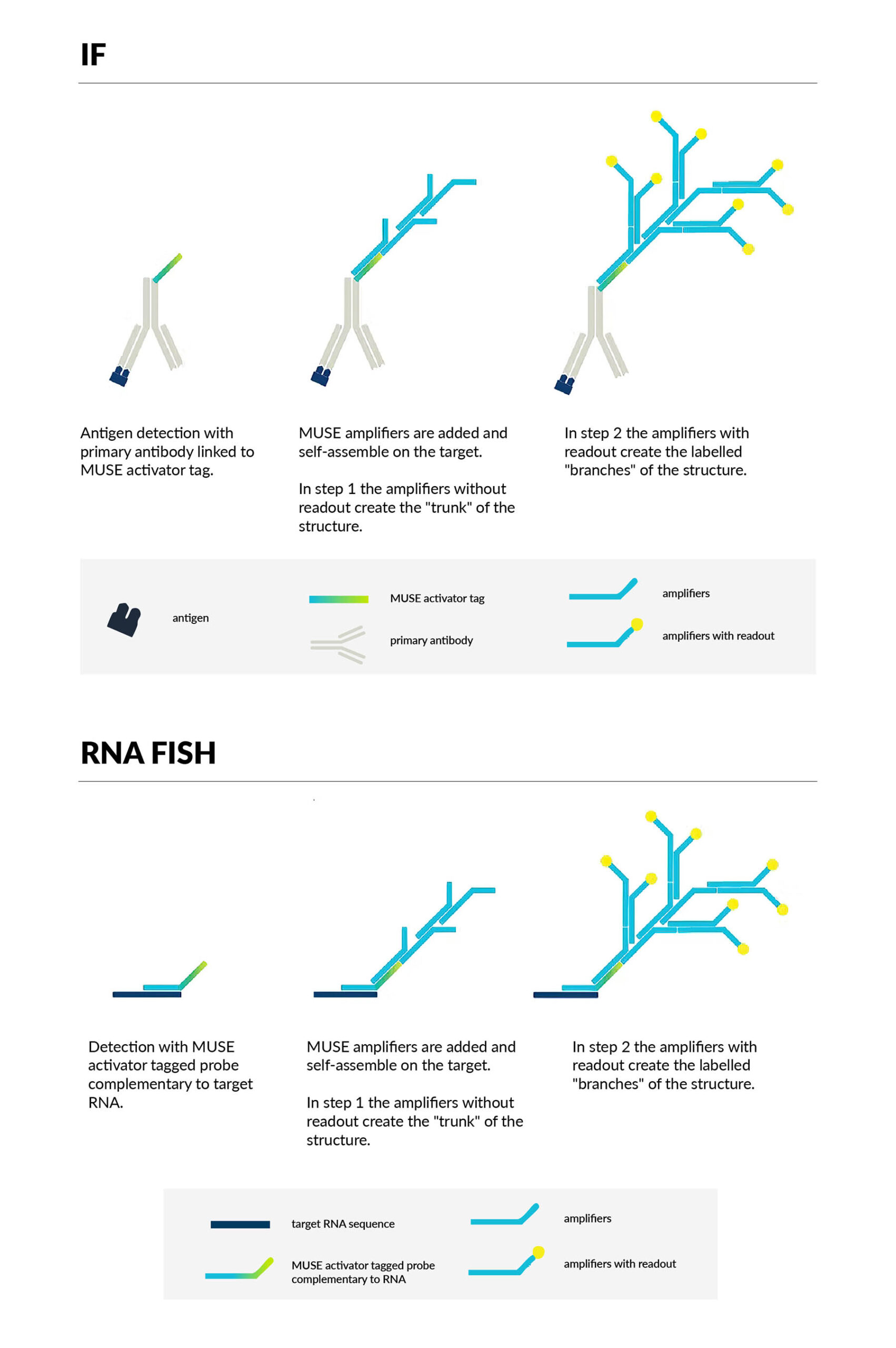
MUSE® is an enzyme-free self-assembling DNA nanotechnology which can be used to detect several proteins as well as nucleic
acids, from 1-plex to 7-plex in one cycle.
MUSE® can be applied in a variety of assays: IHC, IF, FISH, IMC, FACS and more.
MUSE® benefits at a glance:
• Ultra sensitivity
• Real multiplex imaging
• Label flexibility
• Same day results
• Large spectrum of applications
• For any biomarker
• Simple & Robust
• Batch consistency
• Sustainability
MUSE®– how does it work?
Our patented MUSE® reaction drives the enzyme-free assembly of hyperbranched polymers that attach numerous fluorophores, chromogenic enzymes or alternative contrast agents to probe-ligand complexes. The MUSE® reaction is error-corrected by a key and lock molecular mechanism that ensures precise background control and orthogonality and a very high signal-to-noise ratio. MUSE® is a robust, quick and simple reaction: two steps, room temperature, no enzymes, no specialized equipment.
"We were facing a roadblock caused by target degradation problems while trying to detect two transcipts sequentially with riboprobes and Tyramide Signal Amplification.
Switching to arcoris bio's MUSE nanotechnology allowed us to successfully quantify both targets simply and rapidly thanks to its multiplexed signal amplification and allowed us to conclude our work"
"We needed a solution for sensitive multiplex RNA FISH for a study on human pancreas FFPE sections. Having previously faced complications with other commercial products, we turned to arcoris bio's MUSE nanotechnology. With arcoris bio's efficient assistance and reagents, we rapidly obtained results that matched our expectations and allowed us to finalize our study by complementing our RNAseq data."
MUSE® publications
Generation of human islet cell type-specific identity genesets
(MUSE® used for multiplex RNA FISH on FFPE sections)
Essential role of Cp190 in physical and regulatory boundary formation
(MUSE® used for multiplex RNA FISH on drosophila embryos)
Chromosome-level organization of the regulatory genome in the Drosophila nervous system
(MUSE® used for multiplex nuclei sorting by flow cytometry with 3 mouse monoclonal antibodies)
Targeting TREM2 signaling shows limited impact on cerebrovascular calcification
(MUSE® used for multiplex RNA FISH on mouse brain thick sections)
MUSE® application notes